
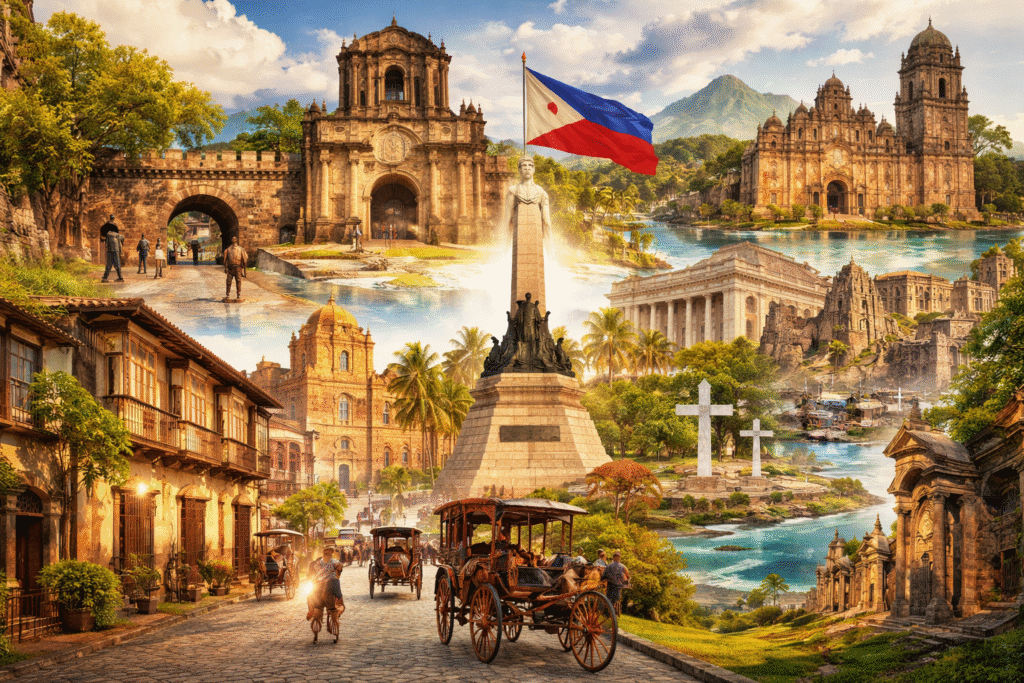
The Philippines offers a rich historical journey for travelers who want to look beyond tropical scenery and discover how the nation was shaped over centuries. Its heritage is especially fascinating because it reflects a succession of colonial periods that each left visible and lasting marks. Spanish rule transformed religion, architecture, and urban organization; American occupation brought new political systems and educational reforms; and the Japanese wartime presence added another difficult layer to the country’s historical memory. Through churches, plazas, fortresses, ancestral homes, and war memorials, visitors can follow the complex evolution of Filipino society.
A central destination for anyone exploring the colonial past is Intramuros in Manila. Built by the Spanish in the late sixteenth century, this fortified district served as the administrative heart of the colony. The enclosed city was carefully planned, with churches, convents, government buildings, and elite residences placed within defensive walls. Its structure illustrates how colonial authorities attempted to impose order through both spatial control and social hierarchy. Nearby stands Fort Santiago, one of the most symbolic sites in Philippine history. Originally intended as a military stronghold, it later became associated with suppression and nationalism, particularly through its connection to José Rizal. Today, the site allows travelers to reflect on how places of power can also become places of memory and resistance.
Churches throughout the Philippines are among the strongest reminders of the Spanish period. They were often the first permanent stone structures built in many towns and became the physical center of community life. The spread of Catholicism under Spain deeply influenced festivals, customs, family traditions, and even local identities. Structures such as San Agustin Church in Manila and the UNESCO-recognized Baroque churches in Paoay, Miagao, Santa Maria, and Iloilo reflect this fusion of faith and authority. Their thick walls, ornate altars, and defensive features also reveal how architecture was adapted to local conditions, including earthquakes and regional conflict. These churches are important not only for their artistic value but for what they tell us about cultural conversion, adaptation, and continuity.
For a more intimate look at colonial-era life, Vigan remains one of the most revealing destinations. Unlike isolated monuments, Vigan preserves a broader urban environment where the past can still be experienced in a tangible way. Its streets, horse-drawn carriages, merchant houses, and old trading atmosphere reflect the connections between local elites, Chinese merchants, and Spanish administrators. The town’s architecture demonstrates that colonial history in the Philippines was never purely European; it was shaped by multiple interactions, including Asian trade and indigenous practices. This makes Vigan especially significant for travelers seeking a more nuanced understanding of the past.
The American era also deserves close attention. When the United States took control after Spain, it introduced a different style of governance centered on public education, sanitation, infrastructure, and civil administration. Buildings from this period often feature neoclassical designs and wider avenues that contrast with the enclosed world of Spanish towns. In Manila and many provincial capitals, public schools, municipal halls, and government offices still reflect the American ambition to reorganize the colony through institutions rather than missionary expansion alone. These spaces help tourists see how colonial influence shifted from religious conversion to administrative modernization.
Historical tourism in the Philippines also includes wartime remembrance. Corregidor Island, battlefields, and memorials to the Japanese occupation reveal a painful chapter of destruction, occupation, and liberation. These sites show the Philippines not only as a colony but also as a battleground and strategic military zone. Exploring them adds emotional depth to the travel experience, connecting heritage with sacrifice and national endurance.
The historical attractions of the Philippines do more than display old buildings. They reveal how foreign powers shaped the country, how Filipinos responded, and how memory continues to live in architecture, tradition, and public space. For travelers, this makes the Philippines a destination where history is not distant—it is still present in the streets, stones, and stories of everyday life.