
The Weverse Moment: When Filipino Acts Went Global on Their Own Terms
In March 2026, a quiet but seismic shift occurred in the global superfan platform ecosystem. Weverse, the fan community app built by HYBE, announced that P-pop icons SB19 and BINI would officially join the platform as the first Philippine pop artists to do so. The symbolism was unmistakable. For years, Filipino fandoms had been the consumers of Korean and Western pop culture on global platforms. Now, Filipino acts were entering those same spaces as producers of cultural content—with their own dedicated global communities.
SB19, composed of Pablo, Josh, Stell, Ken, and Justin, had already made history as the first Filipino act to perform at Lollapalooza in Chicago. BINI, dubbed the Nation’s Girl Group, was announced as part of the Coachella Valley Music and Arts Festival 2026 lineup—another first for an all-Filipino group.
A’Tin’s Four-Peat: The Most Successful Fanbase in Billboard History
The commercial and cultural momentum of P-pop is inseparable from the organized intensity of its fandoms. In August 2026, SB19’s A’Tin fandom claimed its fourth consecutive Billboard Fan Army Face-Off title, defeating Harry Styles’ Harries with 70.9 percent of the final vote. This victory made A’Tin the most successful fanbase in the competition’s history, surpassing T-ara’s Queens, which had held the record with three consecutive wins.
What makes A’Tin’s dominance particularly significant is the context. Before SB19, every Fan Army Face-Off winner was a fandom of a South Korean group. The Filipino fandom broke that monopoly through sheer organizational discipline—mobilizing votes across time zones, coordinating campaigns on social media, and sustaining momentum across multiple rounds against fanbases of artists like Hilary Duff, Megan Thee Stallion, and Zara Larsson.
The P-Pop Convention: Institutionalizing a Movement
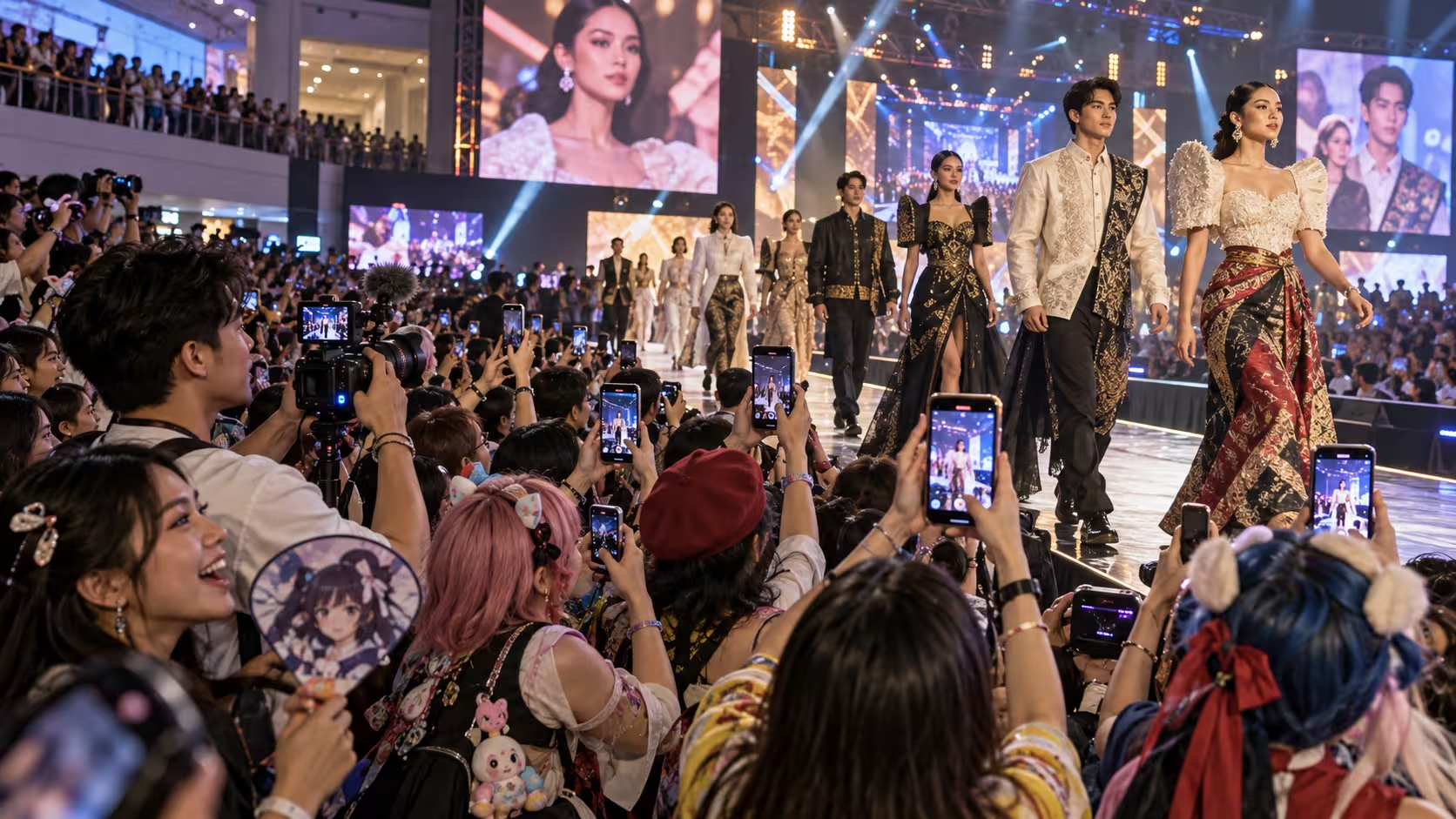
In June 2026, Billboard Philippines hosted the inaugural P-POP UNITE: The Convention at SPACE at One Ayala in Makati City, introducing the P-pop Class of 2026—1621, AJAA, HORI7ON, VVINK, XONARA, and YGIG—alongside returning acts like ALAMAT, BGYO, KAIA, and VXON. The convention was more than a showcase. It was an institutional acknowledgment that P-pop had graduated from niche curiosity to a legitimate industry with its own pipeline, fanbase infrastructure, and commercial ecosystem.
“The Convention is the first… held on June 24, 2026 at SPACE at One Ayala in Makati City,” Billboard Philippines reported, noting that fans moved through interactive booths, photo opportunities, and fan-focused activations that created an immersive experience beyond the main stage.
Why P-Pop’s Global Rise Is Different
P-pop’s international expansion is not simply a replication of the K-pop model. Filipino acts are entering global platforms with pre-existing, deeply mobilized fandoms that have been operating in the digital wild for years. When SB19 drew huge crowds at a Los Angeles pop-up event in July 2026, it was not because of label-driven marketing but because A’Tin had already established its presence across social media, streaming platforms, and fan networks.
The Philippine creative economy, which reached ₱2.12 trillion in 2025 and contributed 7.6 percent to GDP, provides the macroeconomic backdrop for this cultural export. With ₱320 billion in creative goods exports and ₱427 billion in creative services exports, the Philippines is no longer just an importer of entertainment—it is becoming an exporter.