
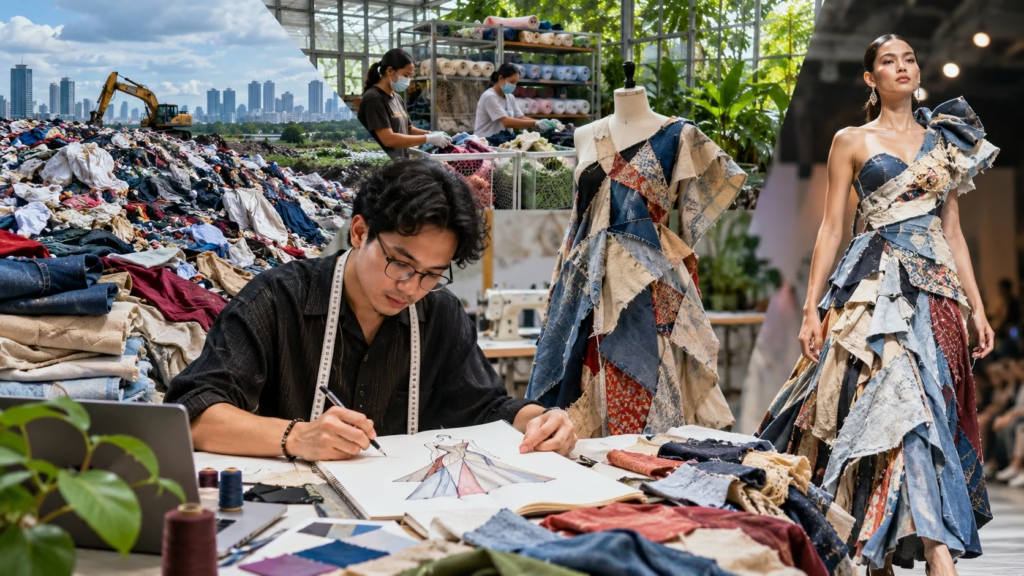
A Policy Shift With Material Consequences
In December 2025, the Quezon City government approved the Textile Sustainability and Circularity Ordinance, a measure that moves beyond voluntary recycling drives and establishes a citywide system for reducing textile waste through reuse, repair, repurposing, and recycling. The ordinance is not framed primarily as an environmental regulation. It is presented as an economic development instrument—a way to keep scrap fabric out of landfills while creating opportunities for aspiring entrepreneurs and artisans.
The timing is significant. The Philippines generates roughly 267,711 tonnes of textile waste annually, equivalent to about 1.6 percent of total municipal solid waste. A substantial portion of this material is deadstock: unsold garments, factory offcuts, and overrun fabric that never reaches a retail shelf. Until recently, much of it was treated as residual waste. The ordinance reclassifies it as a secondary resource with a formal pathway back into production.
Inside the Payatas Circularity Hub
The operational core of the policy is the Circularity Hub, a facility model designed to collect, sort, repair, upcycle, and recycle fabric materials before they reach the landfill. The first hub opened in Barangay Payatas in October 2025, in partnership with Cebu-based social and cultural enterprise ANTHILL Fabric Gallery. The facility is equipped with weaving looms, cutting machines, production areas, and a showroom—infrastructure that allows local artisans to convert discarded textile scraps into new, marketable products.
Payatas is a deliberate choice of location. The community sits near one of Metro Manila’s largest waste facilities and has a long history of informal textile recovery: women sorting fabric scraps from the dump and weaving them into rags and mats for street sale. The hub formalizes that labor, connects it to design expertise, and inserts it into a higher-value product chain. The output is no longer floor mats sold at informal margins but woven goods, garments, and home accessories positioned for retail and institutional buyers.
From Collection to Collection-Worthy
The hub model addresses a critical bottleneck in deadstock fashion: material consistency. Designers can work with irregular fabric, but doing so at scale requires sorting by fiber, color, weight, and condition. The Circularity Hub performs this grading function, transforming a chaotic waste stream into categorized inputs that artisans and small enterprises can use predictably.
The economic implications extend beyond the individual artisan. The ordinance includes provisions for incentives to businesses that participate in the circular textile economy, and it establishes a Textile Sustainability and Circularity Committee tasked with drafting a five-year action plan. This creates a policy signal that deadstock is not a temporary advocacy theme but a long-term material category with institutional backing.
Scaling the Circular Textile Economy
The next test is replication. A single hub in Payatas cannot absorb the metro-wide volume of textile waste, but it functions as a proof of concept. The Quezon City government has indicated that additional hubs will be established, with a mandate to support community-based enterprises rather than centralized industrial processing. That decentralized model aligns with the geography of deadstock: waste is generated across many factories, warehouses, and retail points, and collection systems must be equally distributed.
For the fashion sector, the implication is that deadstock supply is becoming infrastructural. Designers who previously relied on ad hoc relationships with factories or warehouse managers will increasingly be able to source through formalized channels. That shift lowers the transaction cost of circular design and makes it possible to plan collections around known material volumes rather than speculative sourcing. The value created is not only environmental—it is the difference between a one-off upcycled capsule and a repeatable, high-value product line rooted in community production.