
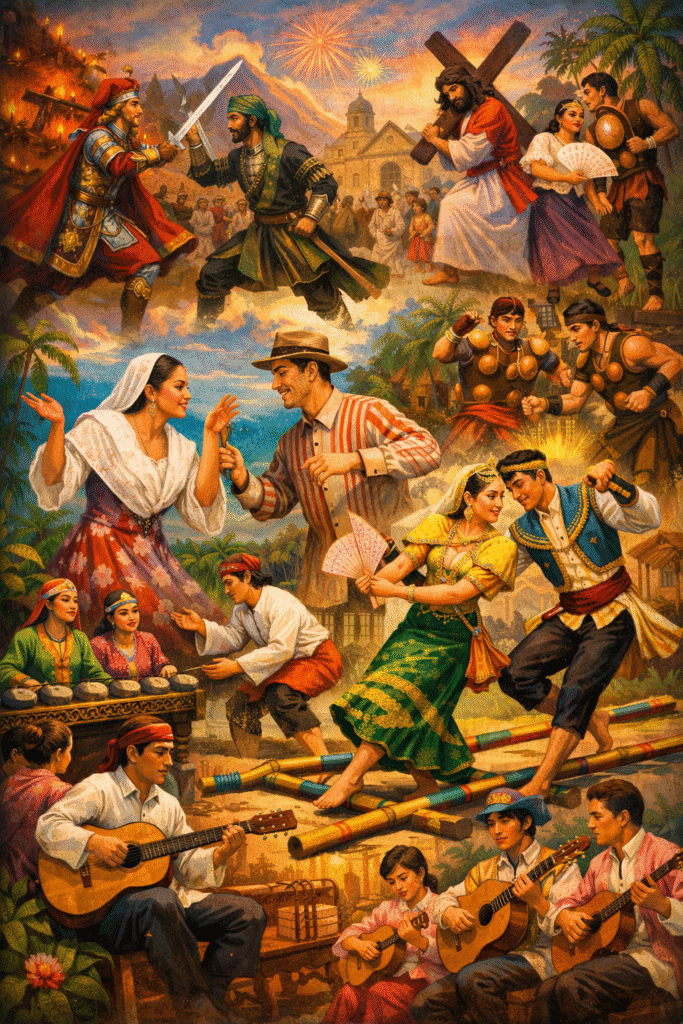
The traditional entertainment of the Philippines reflects the country’s long and layered cultural history. Spread across more than seven thousand islands, Filipino communities developed many distinct ways of celebrating, performing, and telling stories. These entertainments were not created only for leisure. They were closely connected to harvests, religious observances, courtship, village gatherings, and public festivals. Because of this, traditional performance in the Philippines often carries social meaning, historical memory, and local identity all at once.
A striking feature of these traditions is the use of nonverbal expression. Before modern mass media, communities relied heavily on face-to-face performance, and body movement became a powerful way to communicate stories. Gesture-based entertainment appears in folk rituals, community drama, and dance. The Bicolano dance Pantomina is one of the clearest examples. Known as a courtship dance, it uses subtle and playful movements to imitate romantic pursuit. Instead of telling a story through lengthy speech, the dancers express attraction, modesty, and interaction through controlled steps and physical expression. This gives the performance a universal quality, since even viewers unfamiliar with the exact lyrics or regional language can follow the emotional message.
Beyond dance, traditional theater has long attracted Filipino audiences. The komedya or moro-moro became a popular public performance during the Spanish period. It usually presents conflict between opposing groups, noble heroes, dramatic entrances, and highly decorative costumes. The dialogue and movement are stylized, making the performance both theatrical and visually memorable. Another deeply rooted tradition is the senakulo, performed during Holy Week. Although religious in subject, it also functions as community theater, drawing crowds and requiring the cooperation of actors, singers, costume makers, and organizers. These forms demonstrate that entertainment in the Philippines has often existed at the intersection of belief, education, and spectacle.
Musical tradition gives these performances their energy and emotional texture. In the southern Philippines, especially among Muslim and indigenous groups, the kulintang ensemble is central to ceremonial and festive life. Its layered gong patterns create both rhythm and atmosphere, allowing music to become an active part of communal celebration. In other regions, the rondalla tradition introduced an ensemble sound built around string instruments such as the bandurria and guitar. Folk dances, local plays, and civic festivities often rely on this musical foundation. In Filipino tradition, music is not a background element; it directs pace, signals transitions, and intensifies the dramatic mood.
Folk dance remains one of the most recognized forms of traditional entertainment in the country. Tinikling is admired for its speed and precision as dancers step through moving bamboo poles. Cariñosa presents a softer image, often portraying romance through delicate movements and the use of props such as fans or handkerchiefs. Singkil, associated with the Maranao people of Mindanao, is known for its elegance and royal character. The dancer’s careful movement through bamboo poles symbolizes grace under pressure and reflects aristocratic refinement. Other well-known dances, including Maglalatik and Subli, show how Filipino communities transformed labor, devotion, and playful competition into art.
In the present day, these traditional forms continue to survive through festivals, cultural institutions, schools, and tourism events. Their lasting value lies not only in their beauty but also in their ability to preserve heritage. Traditional Filipino entertainment shows how a nation can tell its story through movement, rhythm, costume, and shared performance.