
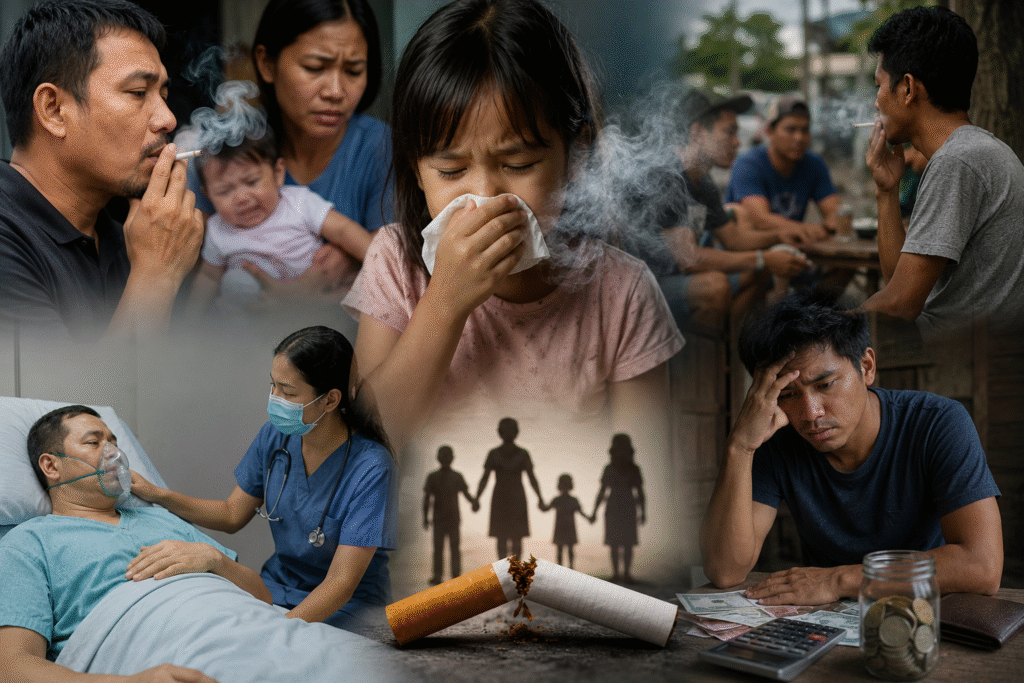
In the Philippines, smoking is more than a personal lifestyle choice. It is a family health issue, a community challenge, and a public health concern that continues to affect millions of lives. While the smoker faces direct health risks, the people around them often carry part of the burden through secondhand smoke exposure, financial strain, and emotional stress caused by tobacco-related illness.
Filipino households are often close-knit, with multiple family members sharing the same living space. This makes secondhand smoke especially concerning. When someone smokes indoors, near windows, outside doorways, or in shared family areas, harmful particles can remain in the air and cling to clothing, curtains, furniture, and walls. Children and older adults are particularly vulnerable because their lungs and immune systems may be more sensitive to smoke exposure.
Children exposed to cigarette smoke may face higher risks of asthma attacks, coughing, ear infections, and respiratory illness. Pregnant women exposed to tobacco smoke may also face greater health concerns for themselves and their babies. For families already managing limited income, repeated doctor visits and medicine costs can become a serious burden.
Smoking also increases the risk of chronic disease among adults. Lung cancer is the disease most commonly associated with cigarettes, but tobacco use is also linked to heart disease, stroke, chronic bronchitis, emphysema, and several other cancers. Many of these illnesses develop slowly, which can make smoking seem less dangerous in the short term. By the time symptoms become severe, treatment may already be complicated and expensive.
The financial impact is one reason public health advocates continue to push for stronger tobacco control. A daily cigarette habit can consume money that might otherwise support food, school needs, utilities, savings, or healthcare. For working adults, smoking-related disease may lead to missed workdays, reduced productivity, or early disability. The cost is not only medical; it affects the stability of entire households.
Cigarette use also has a social dimension. In some communities, smoking is associated with stress relief, masculinity, social bonding, or workplace breaks. These cultural patterns can make quitting difficult, especially when a smoker is surrounded by friends or relatives who also smoke. Nicotine dependence is not simply a lack of discipline. It is an addiction that affects the brain, mood, and daily routine.
The Philippine government has introduced several tobacco control measures, including graphic health warnings, tobacco taxation, smoke-free rules, and restrictions on advertising. These policies are designed to reduce smoking rates, discourage young people from starting, and protect non-smokers from exposure. However, the success of these measures depends on consistent enforcement and public cooperation.
Health education remains essential. People are more likely to support smoke-free homes and public spaces when they understand the real effects of tobacco exposure. Doctors, teachers, parents, and local leaders can help normalize conversations about quitting and prevention. Even small changes, such as making the home completely smoke-free, can reduce risk for children and other family members.
For many Filipino families, the decision to quit smoking can become an act of protection. It protects lungs, hearts, savings, relationships, and future opportunities. The more communities recognize smoking as a shared health issue, the easier it becomes to build a culture where breathing clean air is treated as a basic right.