
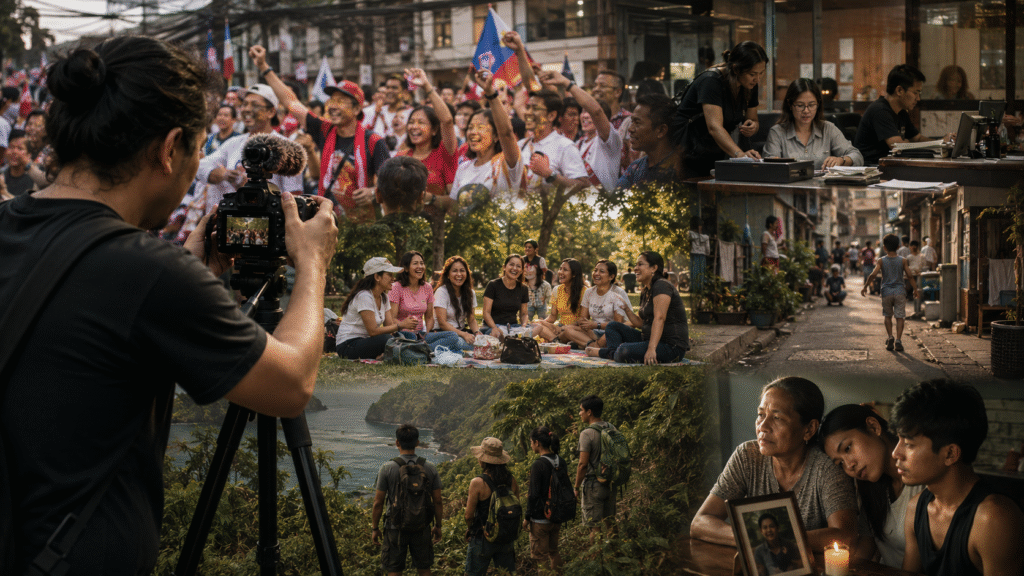
Philippine documentary filmmaking covers a far broader territory than conventional images of poverty, disaster, or political crisis might suggest. Its filmmakers have created works about national elections, press freedom, missing activists, overseas workers, environmental defenders, family memory, and communities living far from the centers of political power.
This variety reflects the complexity of the Philippines itself. The country’s geography, languages, colonial past, strong migration culture, and recurring political conflicts create many competing versions of national experience.
For documentary filmmakers, that complexity is not a problem to simplify. It is the material of the work.
Elections and Democracy Through the Documentary Lens
Some of the most internationally visible Philippine documentaries have focused on democracy and political power.
Ramona S. Díaz’s And So It Begins looks at the tense environment surrounding the 2022 presidential election. Premiering at Sundance in 2024, the film observes how campaign movements, journalism, disinformation, and citizen participation intersect during a major political transition.
Díaz had already examined similar pressures in A Thousand Cuts, a documentary following Nobel Peace Prize-winning journalist Maria Ressa and the wider struggle over media freedom.
The films are connected by a crucial journalistic idea: institutions become easier to understand when audiences see the people trying to work inside them.
JL Burgos takes a more personal route in Alipato at Muog. His documentary investigates the disappearance of his brother, activist Jonas Burgos, in 2007. The film’s public controversy in 2024 pushed questions of censorship, accountability, and unresolved political violence back into national conversation.
The case demonstrates how a documentary can be more than a record of the past. It can become part of an ongoing event.
Migration, Labor, and Lives Beyond the Philippines
The diversity of Filipino nonfiction cinema also comes from the millions of Filipinos whose lives extend beyond the country’s borders.
Baby Ruth Villarama’s Sunday Beauty Queen follows domestic workers in Hong Kong who participate in beauty pageants on their days off. Instead of reducing overseas Filipino workers to remittances and labor statistics, the film gives space to performance, friendship, loneliness, and personal ambition.
This perspective changes the meaning of migration. The workers are neither anonymous economic heroes nor passive victims. They are individuals building communities under demanding conditions.
The film also illustrates how Philippine documentaries frequently cross geographical boundaries while remaining deeply connected to Filipino identity.
Environmental Conflict and the Politics of Survival
Other filmmakers focus on communities fighting for physical territory.
Karl Malakunas’s Delikado follows environmental defenders in Palawan confronting illegal logging and threats linked to the protection of natural resources. The story connects a specific island province with wider global debates about biodiversity, land, development, and the risks faced by environmental activists.
Alyx Ayn Arumpac’s Aswang, meanwhile, documents the human consequences of the Philippine drug war. Its emphasis on vulnerable communities shows how national policies are experienced at street level, far from official speeches and government statistics.
Preserving a Century of Nonfiction Storytelling
The country’s documentary culture has roots extending back around 100 years. The Daang Dokyu project was established to celebrate and examine a century of Philippine documentary filmmaking, bringing historical and contemporary works into a broader conversation.
Its archive and programming provide important context for understanding how Filipino nonfiction cinema has responded to changing periods of war, dictatorship, democracy, migration, and digital media. Readers can explore the initiative through Daang Dokyu.
Today, cheaper production technology has made documentary work more accessible, but filmmakers still face challenges involving funding, distribution, preservation, and political pressure.
What makes Philippine documentary cinema distinctive is not one visual style or political position. Its strength comes from disagreement, regional difference, personal testimony, and the constant effort to record realities that might otherwise disappear from public memory.