
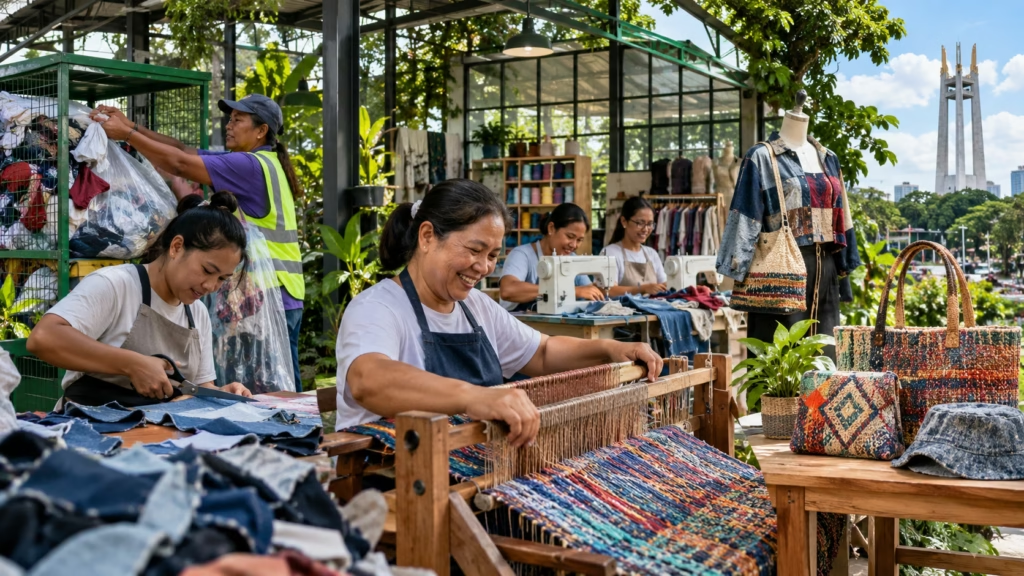
The most visible symbols of circular fashion are often consumer-facing: tote bags made from billboards, sneakers woven from pineapple leaves, evening bags crafted from bottle caps. These are important. But the deeper transformation is occurring upstream—in the factories where fabric scraps are generated before a garment ever reaches a store.
The TexRev Model: Industrial Symbiosis in Practice
In 2025, the Department of Science and Technology’s Philippine Textile Research Institute (DOST-PTRI) partnered with homegrown clothing brand Bayo Manila to launch the Textile Revitalized (TexRev) project. The initiative targets a specific, stubborn problem: post-industrial fabric scraps. Bayo alone generates approximately 16 metric tons of textile waste annually—material that, without a recycling system, contributes directly to landfill overflow.
TexRev intervenes at the pre-consumer stage. The process begins with collecting and sorting waste by color and material, followed by cutting, shredding into fibers, and quality testing. Impurities are removed, and the resulting fibers are spun into yarns, often blended with virgin materials for strength. These yarns are then woven into new fabrics and finished for use in apparel and home textiles. The environmental logic is straightforward: reintroducing existing fibers into production reduces the water and energy demand associated with cultivating and processing virgin raw materials.
Beyond One Brand: Scaling the Circular Supply Chain
The TexRev project is explicitly designed to serve garment manufacturers broadly, not just Bayo. By providing an alternative to conventional virgin textiles, it aims to spark systemic change across the industry. This supply-side approach complements the growing ecosystem of design-led circular brands.
Tatler Asia’s 2026 coverage of Filipino bag labels illustrates the diversity of circular innovation. Marricola transforms industrial plastic waste into structured objects through heat and pressure; Pammé employs incarcerated women in Metro Manila to craft beaded evening bags from bottle caps and detergent containers, with five artisans collaborating on each piece over three days; Retaso creates accessories using 98 to 100 percent plastic, collaborating with designers to divert factory-floor textile waste into consumer hands. Kanya Kanya converts bagasse—the fibrous residue of sugarcane—into vegan leather alternatives, supporting local farming communities in Batangas.
The Design Education Gap
Circular supply chains require circular designers. In September 2026, DOST-PTRI, Shell Pilipinas, and SoFA Design Institute signed a memorandum of understanding to integrate circular-design education into fashion and interior design curricula. The partnership connects classroom learning with actual textile technologies and industry applications, including access to TexRev’s waste-to-yarn processes.
The message is clear: the transition from single-use production is not only a materials problem but a knowledge problem. Without designers trained to think in closed loops—where the end of a garment’s life is factored into its conception—industrial recycling will remain a downstream fix rather than a systemic redesign.