
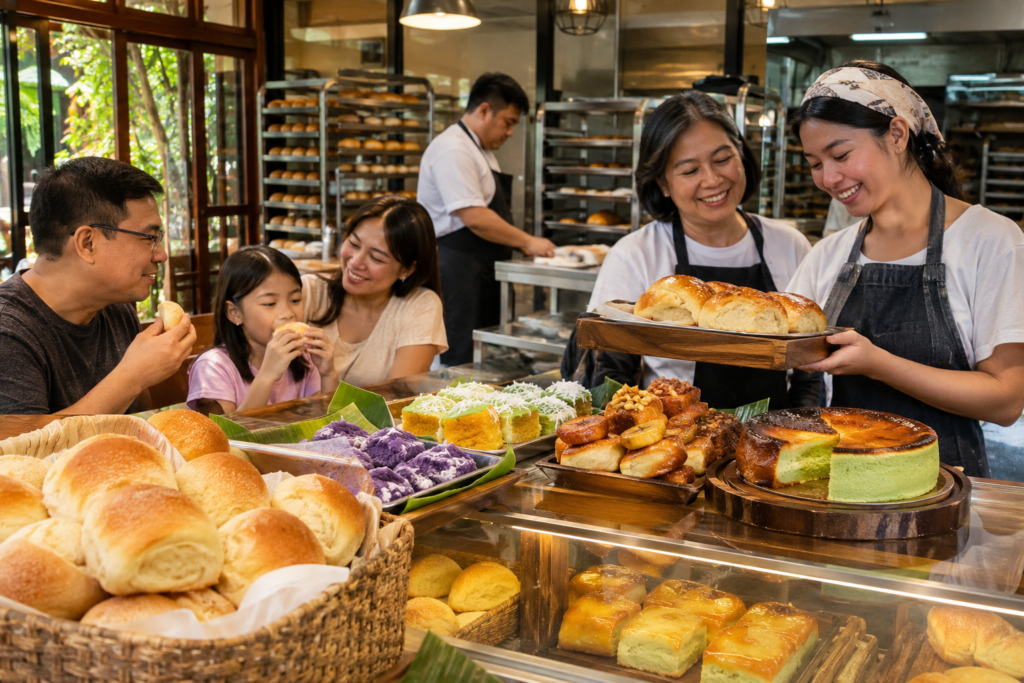
While sourdough captures headlines, a parallel revival is unfolding on the sweeter side of the Filipino bakery case. Kakanin—the collective term for traditional rice- and root-crop-based sweets like bibingka, kutsinta, pichi-pichi, and sapin-sapin—is being reengineered for a generation that grew up on Instagram and global pastry trends. The results are neither pure nostalgia nor wholesale reinvention, but something more interesting: a negotiation between memory and modernity.
From Merienda to Mainstream
The most visible manifestation of this shift appears in the Filipino diaspora’s baking output, which in turn influences tastes back home. Abi Balingit, author of Mayumu: Filipino American Desserts Remixed, has built a following by folding Filipino flavors into unexpected formats: Mexican chamoy as a filling for pichi-pichi, Indian chai masala in leche flan, Japanese furikake and pinipig in Rice Krispies Treats . Her work is not fusion for its own sake. It reflects the reality of immigrant pantries, where substitution is necessity and creativity is born from constraint.
Domestically, the same impulse is reshaping the neighborhood bakery. Gemmae Bake Shop, a Filipino-American bakery in Long Beach with roots in Cavite, now offers pandan ensaymadas and ube cookies alongside traditional monay and pan de coco . The owners describe a delicate balance: older customers come for the monay that reminds them of home, while their children and grandchildren reach for the ube cookie. Both leave satisfied. The bakery becomes a bridge rather than a museum.
The Texture of Memory
What makes kakanin particularly ripe for revival is its texture—glutinous, chewy, sometimes aggressively sticky—qualities that have historically limited its appeal to outsiders but now align with global interest in “textural” eating experiences. The same chewiness that once marked kakanin as provincial is now a selling point. Balingit’s chewy pichi-pichi, elevated with chamoy, speaks to a dessert culture that has moved past sweetness as the primary metric.
This texture-forward approach also carries commercial logic. Kakanin ingredients—rice flour, cassava, coconut milk, pandan—are largely domestically sourced or regionally available, unlike the imported wheat flour that dominates bread production . In a time of currency volatility and supply chain anxiety, sweets rooted in local agriculture offer a measure of resilience. They also tell a story that resonates with consumers increasingly curious about provenance and national identity.
The Limits of Revival
Not every traditional sweet translates easily. Sapin-sapin’s layered complexity and bibingka’s clay-pot preparation resist the standardization that commercial scaling demands. But the bakers driving this revival are less interested in mass production than in selective elevation. They are choosing which traditions to carry forward and which to leave as occasional pleasures. That selectivity is itself a form of respect—an acknowledgment that not everything needs to be modernized to survive. Sometimes, the most radical act is simply to keep making something the old way, and to trust that someone will keep buying it.