
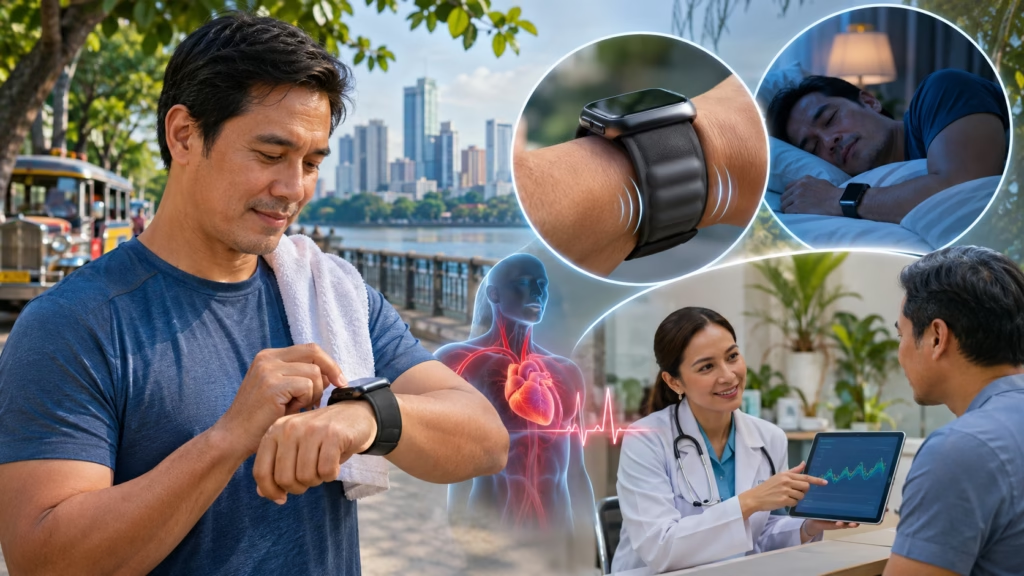
When a Smartwatch Becomes a Medical Device: Inside the Philippines’ Software Regulation Puzzle
A smartwatch that counts steps and a smartwatch that flags an irregular rhythm may sit side by side on the same retail shelf, but Philippine regulators are drawing a line between them that runs through the software itself. In 2025 and 2026, the Food and Drug Administration of the Philippines circulated and revised draft rules for Medical Device Software (MDSW), attempting to classify when code—embedded in a watch, running on a phone, or living in the cloud—crosses from lifestyle convenience into regulated medical function.
The Classification Question
The draft framework distinguishes three categories that matter for wearables. Software as a Medical Device (SaMD) performs a medical purpose without being part of a hardware device. Software in a Medical Device (SiMD) is embedded within and controls a physical device. AI-enabled Medical Device Software (AI-MDSW) uses machine learning to analyze data, generate predictions, or support clinical decisions. General wellness applications—fitness tracking, diet logging, sleep monitoring—are excluded from product authorization, provided their intended purpose stays within lifestyle boundaries.
The line is not about hardware sophistication. A ring that tracks sleep stages may remain a wellness product; the same ring, if its algorithm claims to detect atrial fibrillation and drive clinical management, enters a different regulatory space. What determines classification is the intended use and the clinical weight of the information the software produces.
Risk Classes and Real-World Consequences
The draft adopts a risk-based framework aligned with International Medical Device Regulators Forum principles, assigning MDSW to Classes A through D based on two axes: the seriousness of the condition and whether the software informs, drives, or directly treats/diagnoses it. Class A requires a Certificate of Medical Device Notification; Classes B, C, and D require full registration. For wearable manufacturers, the practical outcome is that the same sensor stack can support multiple products across different risk tiers depending on what the companion software claims to do.
Cybersecurity and post-market monitoring are folded into the lifecycle controls, reflecting a recognition that a device authorized for one algorithm version is not automatically authorized for the next. That lifecycle view matters for wearables more than for static hardware: over-the-air updates can change a device’s clinical function after purchase, and the regulatory framework is attempting to follow the software through those changes.
The Trust Gap the Rules Are Trying to Close
The regulatory push lands in a market where consumer adoption is already moving faster than clinical integration. The Philippines wearable device market generated USD 850 million in 2025 and is projected to reach USD 3.09 billion by 2032 at a 20.5% CAGR, with smartwatches alone accounting for roughly 40% of 2025 revenue. In that environment, the MDSW framework functions less as a barrier than as a translation layer—a way for clinicians, insurers, and patients to distinguish a device whose output can enter a medical decision from one whose output stays in the realm of personal awareness. The rules do not slow the consumer market; they give the clinical market a vocabulary for deciding what to trust.