
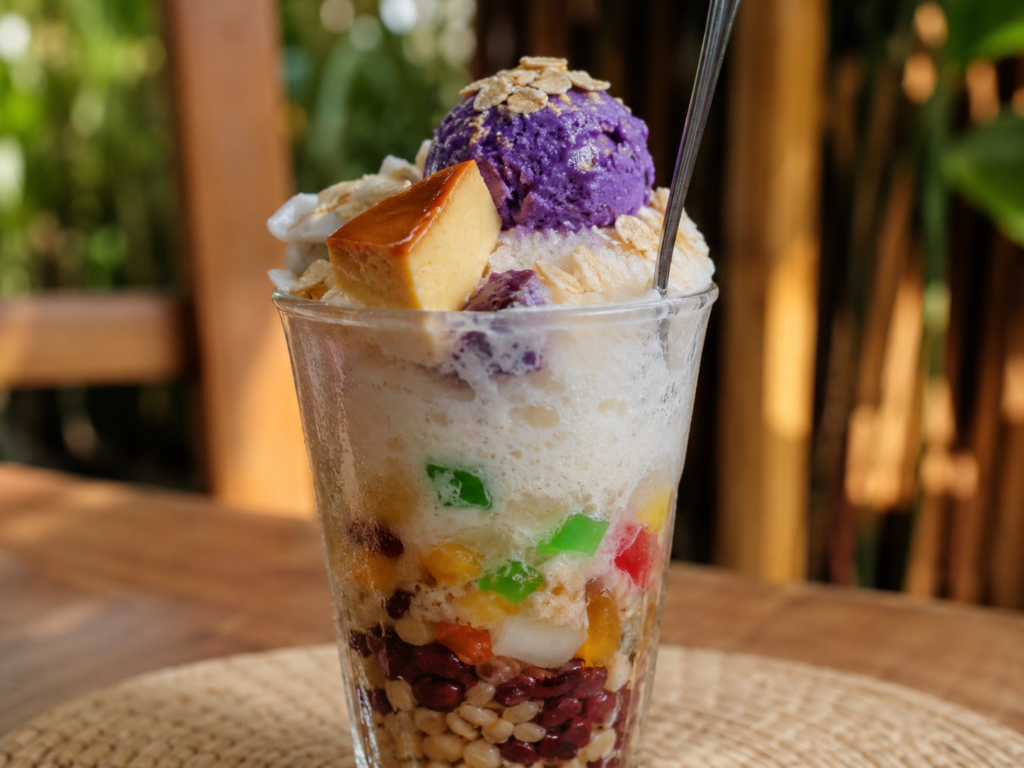
Filipino street culture sings through its beverages, and few sing as sweetly as sago’t gulaman. Despite its playful name that simply marries its two main components—sago (tapioca pearls) and gulaman (agar jelly)—this chilled refreshment is a masterclass in textural satisfaction. Sold from large glass containers stacked on pushcarts, it is the afternoon antidote to tropical humidity, a drink that transports anyone back to simpler childhood days with one sip.
The Dual Identity of a Street Classic
The drink’s genius lies in its structural duality. Sago pearls, often made from palm starch or cassava, offer a soft, gummy chew. Gulaman, on the other hand, is typically cut into colorful cubes—red from food coloring, green from pandan—delivering a firmer, more gelatinous bite. Together, they float in a pool of arnibal, a caramelized brown sugar syrup infused with vanilla or pandan leaves. This dual-chew experience is what makes sago’t gulaman impossible to confuse with any other cooler; it is simultaneously a drink and a snack, requiring both slurping and gentle chewing.
Ingredients: Simple Yet Irresistible
The alchemy behind sago’t gulaman begins with panutsa (unrefined cane sugar) or dark brown sugar, simmered slowly until it thickens into a deep, molasses-like syrup. Pandan leaves are often added to impart a grassy, floral fragrance. The sago pearls are boiled until translucent, then rinsed to prevent sticking, while the gulaman is prepared from powdered agar-agar, set, and diced. Everything is layered with crushed ice, and the cook pours the chilled arnibal over the top. Vendors, many of whom have perfected their family recipes across generations, often customize sweetness levels on the spot—an intimate exchange that no packaged beverage can replicate.
From Street Cart to Social Media Sensation
While sago’t gulaman has been a sidewalk staple for decades, the digital age has given it new life. In 2025, a viral TikTok clip showing a Manila vendor rhythmically scooping the pearls and jelly into tall cups garnered millions of views, sparking a wave of nostalgia among overseas Filipinos. Modern cafés have since elevated the drink, introducing versions with coconut milk, espresso shots, or even cheese foam. The Tourism Promotions Board’s culinary page (https://www.tpb.gov.ph/) notes that such traditional refreshments define the Filipino street food scene. These contemporary riffs prove that even the humblest street beverage can reinvent itself while preserving its unpretentious soul.