
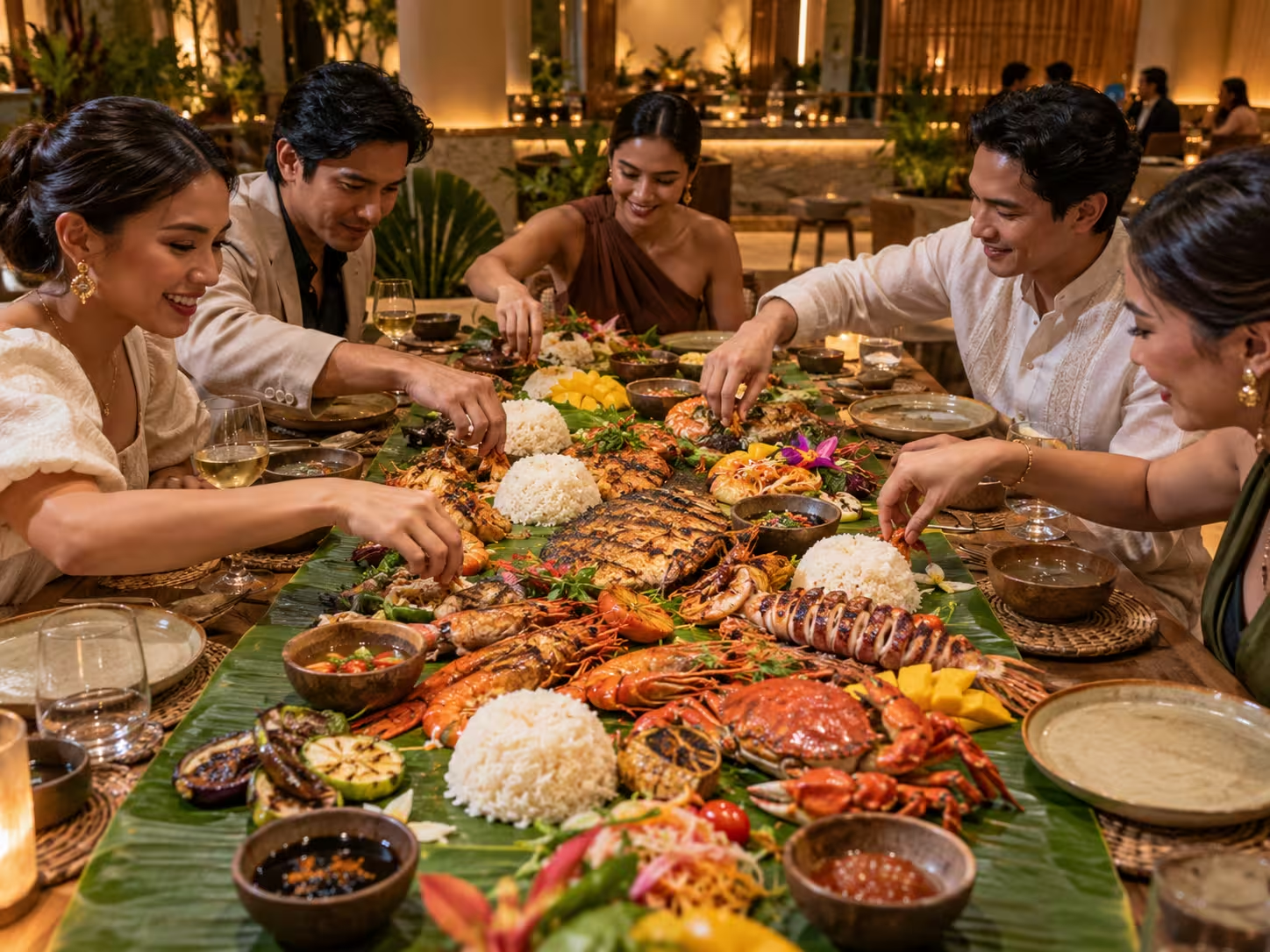
The kamayan feast has always been about abundance and immediacy—food laid out, hands ready, no barriers between the eater and the meal. But what happens when the feast needs to travel? In 2026, the answer is arriving in biodegradable boxes, wrapped in banana leaves, and delivered by motorcycle.
Binalot’s Boodle Box: A Case Study in Practical Nostalgia
In April 2026, Binalot Fiesta Foods—the nearly 30-year-old chain known for wrapping Filipino meals in banana leaves—launched the Summer Boodle Box, a seafood-forward spread designed for beach trips, picnics, and “biglaang get-togethers” (spontaneous gatherings). The box contains the anatomy of a classic boodle fight: halabos na hipon, pinaputok na tilapia, inihaw na baboy, gising-gising, pancit bihon, steamed rice, salted egg, and tomato, all arranged for communal eating.
The innovation lies not in the menu but in the format. The Boodle Box uses tampipi-style reusable containers and biodegradable banana leaves, addressing a longstanding pain point of kamayan culture: the logistics of setup and cleanup. At ₱2,799 for five people and ₱5,099 for ten, it transforms the feast from an occasion requiring planning and space into an accessible, eco-conscious product.
The Broader Portable Feast Economy
Binalot is not alone. The Manila Bulletin described the Boodle Box as “the classic kamayan feast gets a practical upgrade for urban diners and spontaneous get-togethers,” capturing a mood that extends beyond one brand. In Siargao, Chef Migs Barcenas pioneered the inclusion of boodle fights in island-hopping tours as early as 2015, blending local flavors with adventure and proving that the feast could be a mobile experience. More recently, Cev in Siargao launched a year-long kamayan collaboration series that takes guests to secluded island locations, further normalizing the idea that kamayan can happen anywhere—not just at home.
Why Portability Matters for the Modern Kamayan
The portability trend reflects a deeper shift in how Filipinos socialize. Urban schedules are fragmented; gatherings are often last-minute. The traditional kamayan, with its requirement for large tables and extensive preparation, struggled to adapt. The Boodle Box and its peers remove that friction. They allow the ritual to persist—the unwrapping of banana leaves, the shared reach for food—while fitting into a delivery-and-convenience economy.
There is also a sustainability angle. By using biodegradable packaging and reusable containers, brands like Binalot are aligning the feast with contemporary environmental values, ensuring that the “leave no trace” ethos extends from the beach to the packaging itself.
As the Philippine food tourism market accelerates—projected to reach $36.9 billion by 2036—the portable kamayan positions itself as a scalable ambassador. It is no longer just a meal; it is a replicable, exportable experience. The boodle fight has learned to travel, and in doing so, it has secured its relevance for a new generation of Filipino diners.