
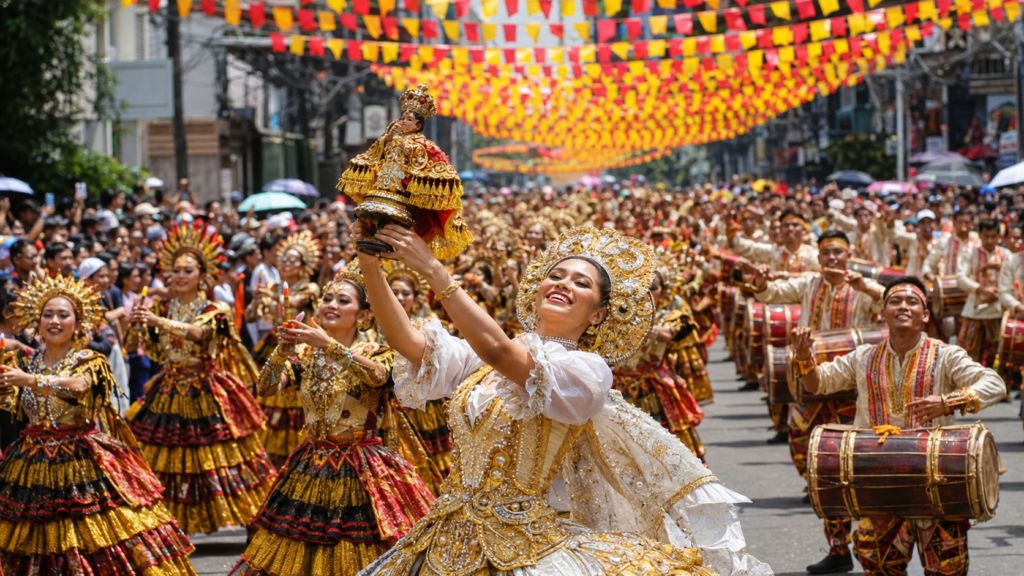
Before the massive floats and corporate sponsorship of newer festivals, there was Ati-Atihan in Kalibo, Aklan. Held every third Sunday of January—January 18, 2026—Ati-Atihan is often called the “Mother of All Philippine Festivals” because its drum-driven street dancing inspired Sinulog and Dinagyang. Unlike more curated parades, Ati-Atihan remains open and spontaneous, with participants covered in black soot and bright body paint dancing alongside spectators.
Ati-Atihan 2026 Dates and Key Events
The 2026 observance opens with a series of novena masses from January 9 to 17 at the Cathedral of St. John the Baptist. The main highlights are:
- January 15–17, 2026: Barangay-level street dancing, Hala Bira competitions, and food fairs along Pastrana Park.
- January 18, 2026: The grand religious procession in the morning, followed by nonstop street dancing from Kalibo Cathedral to the town plaza.
- January 19–20, 2026: Community thanksgiving dances, band performances, and local trade exhibits.
Official schedules can change; the Philippine Department of Tourism’s events page confirms the 2026 dates and offers updated event listings for Aklan province.
Indigenous Roots and Spanish Catholic Overlay
The Ati People and the Barter of Panay
Ati-Atihan translates loosely to “to imitate the Ati,” the dark-skinned indigenous people of Panay Island. The festival re-enacts the ancient pact between the migrating Malay datus and the Ati people, in which the newcomers bartered gold, a golden salakot, and other gifts for land. When Spanish missionaries arrived, they converted the ritual into a celebration of the Santo Niño. Today, the black soot on participants’ faces is both a tribute to the Ati and a sign of devotion. This origin story gives Ati-Atihan a deeper cultural layer than many urban festivals.
What Makes Ati-Atihan Different
The most distinctive feature of Ati-Atihan is the absence of strict barriers between performers and the crowd. In many areas, spectators can join the dancing, chant “Hala Bira! Pwera Pasma!” and move with costumed groups. Drumbeats are loud, continuous, and unscripted; many groups use indigenous rhythm patterns handed down through generations. In 2026, local organizers are expanding the “community sadsad” zones to manage the growing number of domestic and international tourists while preserving the festival’s grassroots feel.
Practical Tips for Kalibo 2026
Fly into Kalibo International Airport, which is about 10–15 minutes from the town proper; alternatively, take a 15-minute van ride from Caticlan if arriving via Boracay. Book accommodations in Kalibo or nearby Numancia at least four to six months ahead. Bring a shirt you can throw away after face-painting, wear closed-toe shoes, and carry earplugs if you are sensitive to loud drums. In 2026, local government units have added hydration stations and first-aid posts along the main route. Try local Aklanon dishes such as inubarang manok, binakol, and latik-based sweets from food stalls around Pastrana Park.
Why Ati-Atihan 2026 Deserves Your January Itinerary
Ati-Atihan is not a polished spectator event; it is a living ritual where faith, history, and community identity collapse into one street-level celebration. According to the official tourism calendar, the 2026 edition will include more barangay contingents and a special indigenous Ati community showcase (https://philippines.travel/). That makes it a strong choice for travelers seeking an authentic cultural experience rather than a staged performance.