
The Buyer Room Is Where the Real Runway Begins
Runway applause fades. Buyer orders endure. For Filipino resortwear brands with international ambitions, the critical shift over the past eighteen months has been from showcase participation to buyer engagement—a transition that requires different muscles than design innovation alone.
At CENTRESTAGE 2025 in Hong Kong, seven Philippine-owned fashion labels presented collections to Asia’s leading fashion trade audience . Among them was Alta Bella, a Macao-based Filipino brand whose minimalist resortwear, built from recycled materials and zero-waste techniques, was positioned explicitly as “environmentally-conscious luxury” . The language matters. “Resortwear” alone signals seasonal, disposable, mid-market. “Conscious luxury” signals investment purchase, provenance, and durability—the attributes that justify premium price points in international multi-brand retail.
The Trade Platform Strategy: From Bangkok to Jakarta
The Department of Trade and Industry has been deliberate in placing Filipino brands in front of regional buyers. In July 2025, the Philippine Fashion Coalition brought Anmari & Co. and Basil Manila to the Asia Fashion Thailand Show in Bangkok, targeting Southeast Asian wholesale channels . Earlier, at Indonesia Fashion Week 2025, Anmari showcased artisanal bags made from buntal, rattan, raffia, and Philippine weaves including Yakan and T’nalak—materials with strong provenance narratives for Indonesian buyers familiar with heritage textile value .
The results are incremental but directional. Anmari’s owner described the Jakarta participation as “very fruitful,” with intentions to return . For a sector seeking to move from occasional export shipments to sustained international presence, these repeated appearances build the buyer relationships that translate into seasonal orders.
What Premium Buyers Actually Want from Filipino Resortwear
The commercial logic of premium resortwear differs fundamentally from mass beachwear. A European or Japanese boutique buyer sourcing for a resort collection is not seeking the lowest cost per unit. They are seeking garments that justify a €180–€350 retail price through material story, construction integrity, and the assurance that the product will not appear in a discount channel three months later.
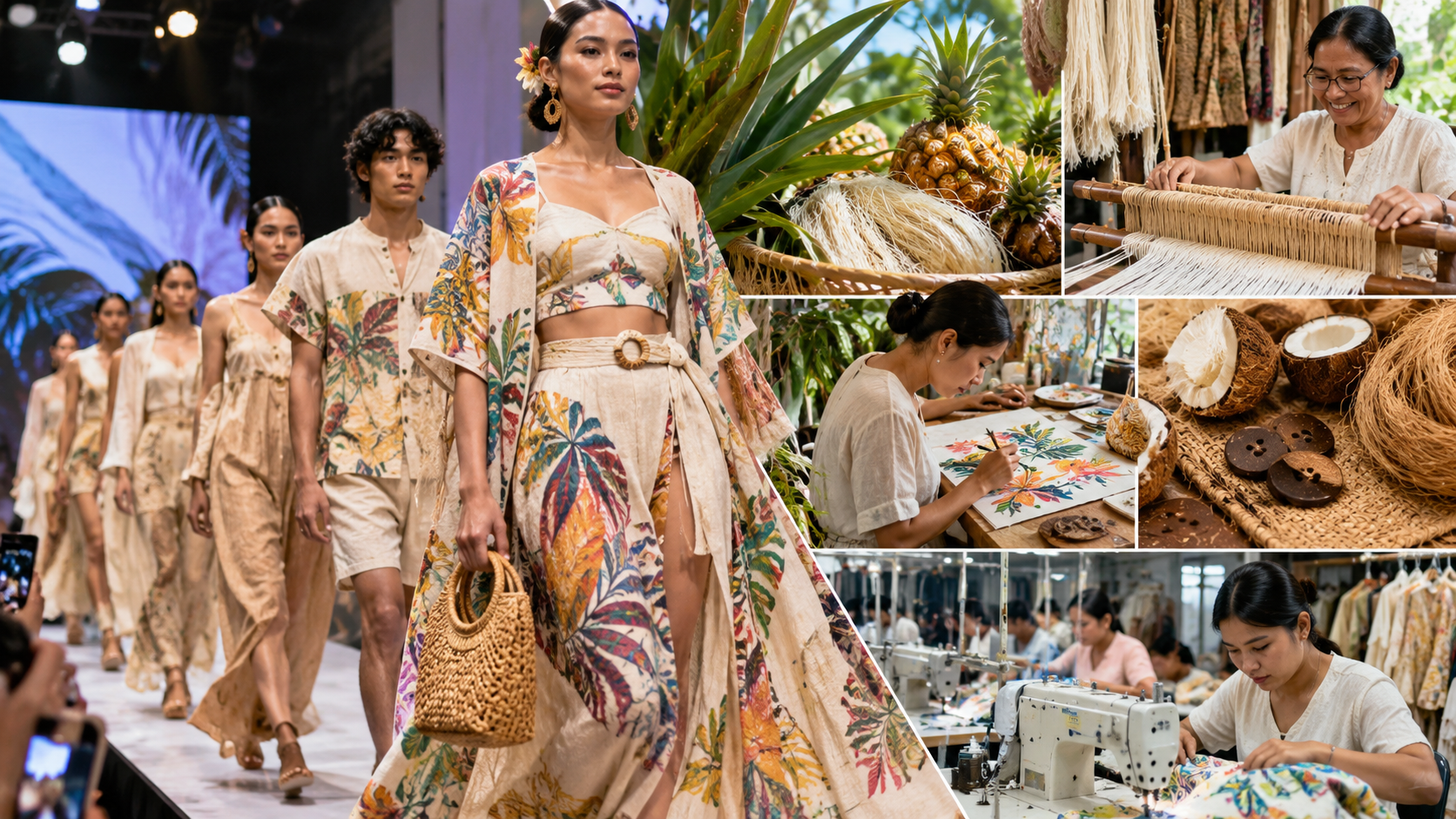
This is where Filipino brands hold an underutilized advantage. The country’s textile heritage—piña, jusi, Inaul, T’nalak—carries inherent scarcity value. When designer Koko Gonzales presented a nine-piece modern Filipiniana collection at Indonesia Fashion Week’s Grand Closing Ceremony using piña, jusi, and Inaul, the garments were positioned not as ethnic costume but as contemporary resort-luxury with material distinction . The same logic applies commercially: a piña resort shirt is not competing with a cotton one. It is competing with a linen one from a European heritage house, and it can win on provenance.
The Production Gap That Threatens Premium Positioning
The uncomfortable counterpoint to creative momentum is manufacturing readiness. The Taytay garment cluster, often described as the country’s garments capital, only convened formal strategic planning on policy, materials, technology, skills, and market development in April 2026 . For resortwear labels seeking consistent quality across repeat orders—the non-negotiable requirement for premium retail placement—the absence of coordinated supply chain infrastructure is a material risk.
Individual brands are improvising. Simonita, a Manila-based resortwear label founded by Katya Lichauco, operates on a bootstrapped model where every cost from raw materials to courier fees is tracked manually, and production runs are small by design . This artisanal approach suits the brand’s positioning but cannot scale to meet the volume expectations of international department store buyers without structural change.
The next phase of Filipino resortwear’s premium journey will be determined not in showrooms but in production planning meetings—where the romance of pineapple fiber meets the reality of lead times, quality control, and minimum order quantities.