
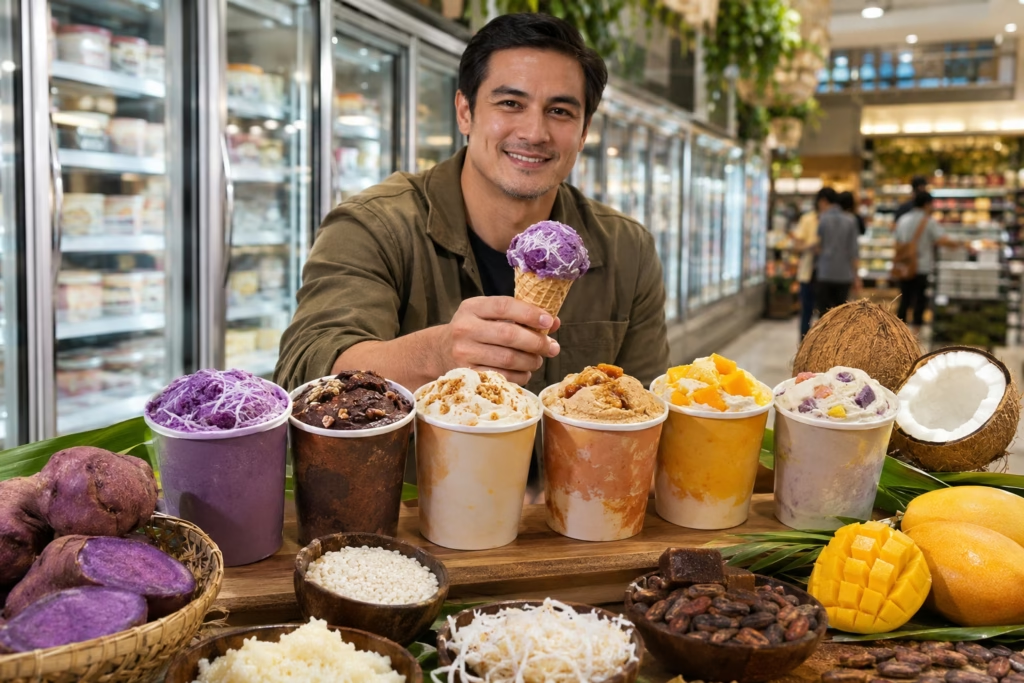
The most consequential change in the Philippine artisan ice cream market is not a flavor. It is a behavior. Consumers are reading ingredient labels before they put a pint in their basket, and they are asking where those ingredients came from. According to Innova Market Insights’ 2025 Global Clean Label Trends report, nearly three in four consumers read ingredient labels before purchasing, and 58 percent say it is important to know the origin of ingredients. That shift is rewriting the competitive logic of frozen desserts.
Davao Mango as the New Benchmark
The ingredient-first approach has a flagship example: single-origin Davao mango, the anchor of a new artisanal frozen dessert line from Baking Therapy by Healthy Options. The dairy-free Mango Sorbet uses the fruit’s natural sweetness and aroma without added sugar, allowing the mango to stand as the product’s entire identity rather than a flavor note buried under cream and syrup.
That is a meaningful departure from the conventional Philippine ice cream model, where fruit flavors are often built from extracts or purees blended into a dairy base. The new logic is closer to specialty coffee or single-origin chocolate: the ingredient is the story, and the production method exists to preserve it.
Gelato’s Denser Architecture
The same line includes artisanal gelato and sorbet made with a gelato approach: more milk, less cream, and less air than conventional ice cream, producing a denser texture and more concentrated flavor. Gelato is also served at a slightly warmer temperature, which allows the primary ingredients—Davao mango, Italian hazelnut paste, Auro tablea, Batangas kapeng Barako—to register more clearly on the palate.
“People aren’t simply looking for dessert—they’re looking for products made with ingredients they can trust and flavors that feel authentic,” said Romy Sia, managing director of Healthy Options. The collection is available at the brand’s Shangri-La Plaza branch and reflects a broader premiumization trend: consumers are not necessarily abandoning indulgence, but they are redefining it around transparency and craftsmanship.
The Market Numbers Behind the Shift
The broader Philippine ice cream market is not exploding in volume terms, but it is reorganizing around value and differentiation. The market reached USD 351.5 million in 2025 and is projected to grow to USD 363.1 million in 2026, reaching USD 445.1 million by 2034 at a CAGR of 2.58%. Within that moderate growth, artisanal ice cream and health-conscious, low-sugar formats represent the fastest-growing segments, supported by premiumization and urban demand for differentiated products.
A separate market assessment notes that 45 percent of consumers are willing to pay more for high-quality products, a figure that directly underwrites the business case for small-batch, ingredient-led frozen desserts. The willingness to pay is not unlimited, but it is concentrated among urban consumers who treat dessert as a curated experience rather than a commodity.
What This Means for Local Producers
The ingredient-first shift creates an opening for producers who can tell a verifiable origin story. Davao mango, Auro cacao from Visayas and Mindanao, Batangas kapeng Barako—these are not interchangeable inputs. They carry geographic identity, and that identity is increasingly the product’s primary marketing asset.
The challenge is scale. Small-batch production preserves ingredient character but limits distribution, and cold-chain expansion beyond Metro Manila remains a bottleneck. Still, the direction is clear: the Filipino artisan ice cream brands gaining traction in 2026 are not winning on novelty alone. They are winning because the label tells a story the consumer can trace. For the full ingredient-first collection details, read the Manila Times report: Davao mango leads the shift toward ingredient-first frozen desserts.